Destruction of the Condor expedition
The InvincibleThe Destruction of the Condor expedition is the first decisive human catastrophe on Regis III and the event that gives the planet’s exploration its moral and epistemological weight. When the Condor is found 180 miles from the Invincible, it is not merely a lost sister vessel but a wrecked scene of investigation: bodies lie around and within it, equipment has been scattered as though hurled from the ship, and the survivors’ final experiences have been reduced to damaged objects, ambiguous images, and broken records. The expedition’s fate compels the crew of the Invincible to ask not only what killed the Condor’s personnel, but whether the disaster can be understood through the familiar categories of attack, intention, and reprisal.
Discovery in the Desert
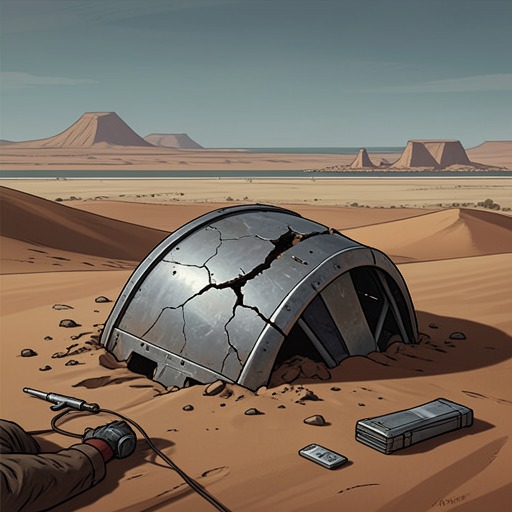
The Condor is located by one of de Vries’s small reconnaissance planes and approached across dunes shaped by prevailing winds. Sand has nearly buried nearby tractors and half-submerged the antimatter cannon, while the ship’s stern remains visible in a hollow protected from the wind. The expedition from the Invincible establishes a ring of vehicles and a force field around the site before approaching the raised personnel ramp. Oxygen canisters, a plastic container, provisions, theodolites, cameras, telescopes, tripods, and mess kits are scattered chaotically at the foot of the rocket. The disorder makes the scene resemble an evacuation or violent expulsion rather than an orderly abandonment.
Rohan’s first direct encounter with the dead gives the catastrophe its unmistakable human form. He turns over a pale, yellowish sphere partly covered by sand and discovers that it is a human skull. The search then reveals additional bones, fragments, and one complete skeleton still wearing a jump suit, with an oxygen mask between its jaws and the pressure gauge fixed at 46 atmospheres. The canister still releases gas when Jarg turns its valve, and the dry desert air has left the steel regulator free of corrosion. The intact equipment contrasts with the annihilation of the people who depended on it, making the absence of an obvious mechanical failure more disturbing.
The Wrecked Ship and Its Evidence
The Condor’s elevator mechanism can be operated from its cage, but its electrical system is dead, forcing the investigators to climb the forty-meter structure by rope. On the hull they find countless small punctures or indentations in the titanium-molybdenum casing. The marks are too closely spaced and too sharply made for any known chisel, and Rohan concludes that they may have resulted from a chemical process. This damage extends the mystery beyond the bodies: the ship itself has been subjected to an agency or reaction capable of affecting its outer armor without simply tearing it apart.
Inside, the ship presents two contrasting conditions. The upper deck is clean and brightly lit after the technicians activate an emergency generator powered by compressed air, with only isolated objects abandoned on the floor. Lower decks, including the cartography cabins, star cabins, messes, crew quarters, radar rooms, engine room, passageways, and gangways, are overwhelmed by incomprehensible chaos. On the bridge, every glass monitor and dial appears to have been pulverized into silvery powder, despite the screens’ shatterproof construction. The library is filled with tangled microfilm, torn books, broken instruments, analytic tapes, and star catalogues whose plastic pages have been ripped out one by one. Clothing and upholstery have been shredded in the clubroom and projection room. In a navigation cabin, a desiccated body lies curled against the wall, effectively mummified by the ship’s cold, dry conditions.
The scale of the destruction makes the Condor appear to have been attacked by something both immensely forceful and strangely selective. The investigators cannot immediately distinguish between violence committed against the crew, damage caused by a physical process, and disturbances produced by the crew themselves during their final hours. The wreck therefore functions as a material record that refuses to become a simple narrative.
Reconstructing the Final Moments
The ship’s log supplies only a partial chronology. After the date of the landing, it contains four entries concerning the ruins explored by the expedition and the appearance of “flies.” One surviving report describes a patrol returning from the ruins that encountered a local sandstorm with heavy atmospheric discharges; despite interference, radio contact continued, and the patrol reported significant numbers of small flies covering something that the available account does not yet clarify. The log establishes that the Condor’s crew had been investigating both the ruins and unusual airborne phenomena before the catastrophe, but it does not identify a perpetrator or explain the transition from exploration to death.
The attempt to recover information from a preserved body introduces another unstable form of testimony. The grave-sounder sends electrical impulses through the brain and follows pathways that had formed a functional whole immediately before death, allowing investigators to listen to what may have been the final contents of consciousness. The method is explicitly unreliable, yet the circumstances make it necessary because so much depends on understanding the Condor’s tragedy. Rohan listens through headphones while Sax adjusts the amplifier, treating the dead body as a final, imperfect recording device.
What emerges is not a dependable eyewitness account. Images suggest that people were moving and bore strange marks, but the neurophysiological interpretation rejects the apparent motion: the engrams are photographic traces, and the image may be a composite, although not in this case. Whether the marks are equally illusory remains unresolved. The grave-sounder preserves perception without guaranteeing context, sequence, or truth. It gives the investigation a fragment of experience while withholding the explanatory structure that would make that experience intelligible.
Bodies, Memory, and the Search for a Cause
At a formal briefing, Horpach reports that teams have recovered twenty-nine bodies within the Condor’s perimeter and thirty-four aboard the ship, including one body preserved in the hibernation chamber. Nygren distinguishes nine mummified bodies from the skeletons and skeletal fragments excavated from the sand. Inside the Condor, low humidity, an almost total absence of bacteria responsible for decay, and low temperatures produced mummification; outside, periods of rain accelerated decomposition, aided by reactive iron oxides and iron sulphides in the sand. The physical condition of the remains thus records the different environments in which the crew died, while offering no direct answer about how they died.
The preserved body eventually provides an even more disturbing consequence of the catastrophe. Sax’s examination concludes that the man’s memory has been completely obliterated. He has lost not only personal identity but speech, reading, and writing; what remains are primitive capacities such as walking, eating when food is placed in his mouth, and grasping objects. Sax calls it more than ordinary amnesia: an annihilation of personality. The Condor disaster has therefore destroyed its victims in two distinct ways—through bodily death and, in at least one case, through the removal of the mental structures that make a person recognizable to others and to himself.
This damage complicates the status of every surviving trace. The log is incomplete, the grave-sounder’s images are uncertain, the ship’s physical wreckage is open to competing interpretations, and the preserved survivor cannot provide a coherent testimony. The expedition can be counted, excavated, and anatomized, but it cannot easily speak in a unified voice.
From Enemy Attack to Planetary Process
At first, the fate of the Condor encourages the Invincible’s crew to imagine an intelligent adversary, perhaps an aquatic civilization or another organized power concealed on Regis III. Rohan suggests that underwater beings might have built a civilization beneath the ocean, but the captain dismisses the idea as implausible, arguing that intelligent aquatic beings would have attempted to conquer the land. The argument reveals how quickly the investigators translate an unknown event into a conflict between recognizable agents: if the Condor was destroyed, someone must have attacked it.
The planet’s geological and biological history gradually unsettles that assumption. Sedimentary strata contain ruddy-black, non-geological metallic material that may be the oxidized remains of enormous deposits of metal fragments. Research shows that life once flourished on land, then disappeared over millions of years as metallic layers began to appear. Yet the recorded radiation amounts—equivalent to no more than twenty to thirty megatonnes of nuclear detonations spread across hundreds of thousands of years—could not have destroyed biological evolution on the required scale. The evidence points toward an ancient transformation whose effects include the disappearance of terrestrial life and the persistence of metallic structures, not a single comprehensible military strike.
The biologist’s proposal is that life remains in the ocean while land has been overtaken by a mechanical form of evolution. Horpach resists treating this as sufficient because the expedition needs certainty and samples before it can return with more than a hypothesis. The possibility that the airborne mechanical formations could eventually threaten space travel also keeps the issue practical: the Condor’s destruction may be a local catastrophe, but it might reveal a broader danger.
Rohan’s later reflection gives the event its final ethical reversal. He recalls the man he killed at close range to stop him from killing others and recognizes that the Condor’s dead continue to shape his own nights through involuntary images. Yet he comes to doubt the language of revenge and heroic survival. If the force that destroyed the expedition was an inanimate process of self-organization rather than a conscious enemy, then humanity’s response risks becoming an attempt to punish a storm or an earthquake. The Condor’s destruction remains a genuine loss, but it also exposes the danger of making human intention the measure of every form of existence. In that sense, the catastrophe is not only the death of an expedition; it is the event that begins to dismantle the assumption that every hostile-looking phenomenon has a hostile mind behind it.